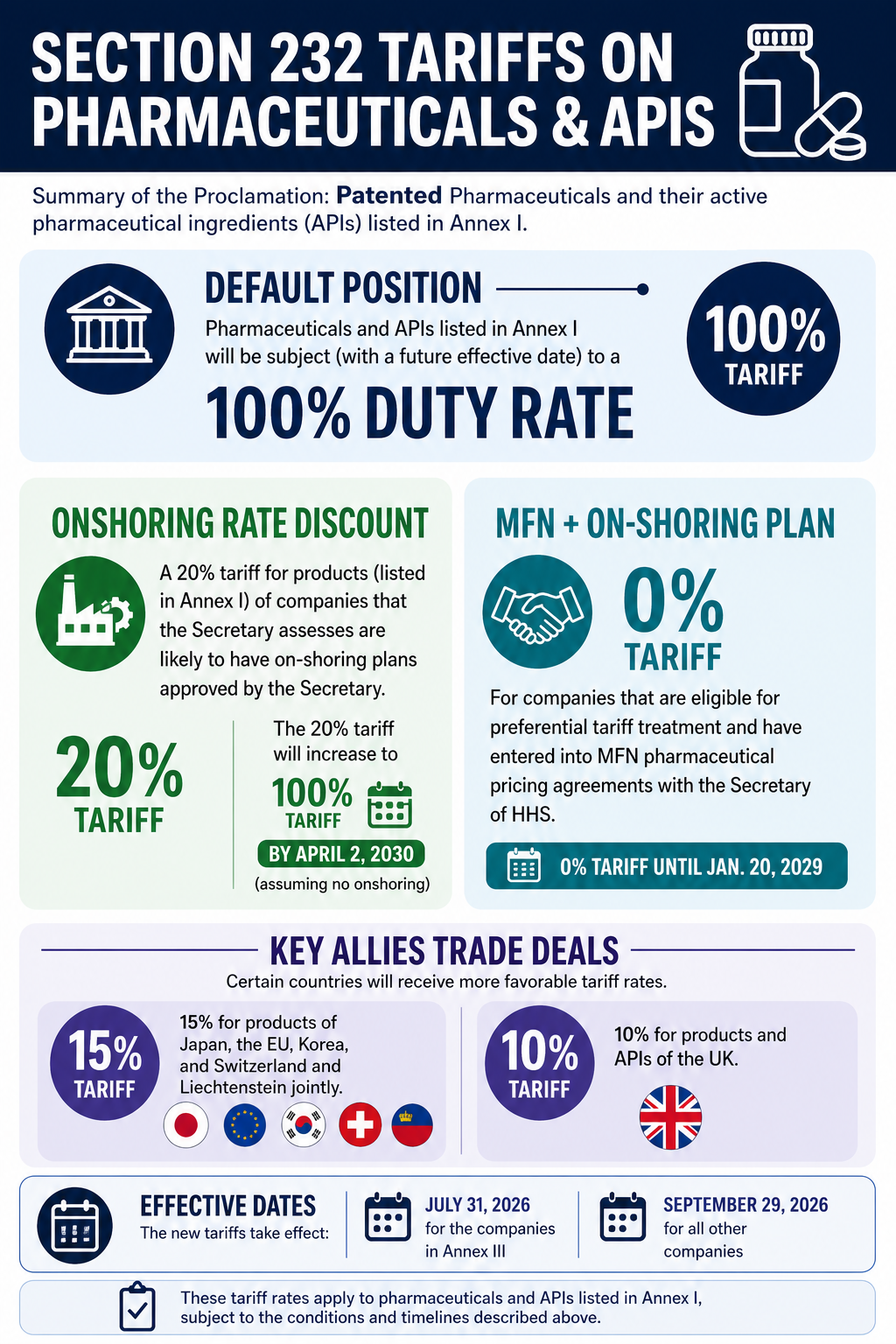
A newly announced tariff regime for branded pharmaceuticals and their active pharmaceutical ingredients (APIs) is poised to reshape sourcing and pricing strategies across the industry.
A few notable elements:
- The proclamation is atypical in that it explicitly identifies certain (larger) companies that have already entered into arrangements with the Commerce Secretary.
- Key allied countries are afforded preferential tariff treatment, reinforcing the role of geopolitics in pharmaceutical supply chains.
- Importantly, there remains a window for companies that have not yet pursued production onshoring or most-favored nation (MFN) pricing agreements to engage with the government and potentially mitigate exposure.
-
These new tariffs are more likely than the IEEPA tariffs to withstand judicial review due to greater deference in national security matters, which is the key policy rationale for these measures
Bottom line: smaller and mid-sized life sciences companies—particularly those not already in dialogue with regulators—should be actively evaluating mitigation strategies now.
That includes not only supply chain planning, but also a disciplined review of tariff classifications and country-of-origin determinations, especially for pipeline and investigational products where sourcing decisions remain fluid.
Please reach out with any questions, PLG’s international trade team is happy to assist companies with this important new policy development.